Everyone I Love is Alive in the Unlimited Present of the City and its Waters
An essay on four incomplete poems
This piece was written across December 2025. The full text is below, and you can watch a video of my unabridged reading, in different locations across Newcastle, in the video embedded here.
Audio version is also available on my Pastoral Scanlines podcast.
Big love. Craig x
New: I created a text adventure game based on this essay. You can play it here:
In recent times I have found myself being increasingly honked at as I cross the road. I don’t know if I’m taking more risks or whether I’m just not judging my timing as well as I used to. Perhaps I’m just giving off vibes that drivers are none too pleased with.
As well, in the past couple of weeks, when I hold bottles of water at certain angles I have found them making a sudden metallic thud. When I inspect the bottles, I confirm they contain only liquid, no solids whatsoever. This has happened with multiple bottles of different makes and materials.
I saw all the pretty faces
all at once; they
did not see me, my rhythm
that goes like this . . / - - \ . .
(when you speak that aloud,
make a sound like a dream is
accelerating and then not).
I’m of the mind that we only arrive at what we’re looking for by way of failure. Not in the sense that you have to fail to succeed, by trial and error, but that the failure is the revelation, the failure is the endpoint - it is the moment where the thing becomes what it was always going to be. When city planning collapses into a network of dead ends and empty courtyards, those urban glitches become the only places worth inhabiting. The intention dissolves, and meaning appears in its place.
There is a line of reason suggesting that the lived experience of our everyday reality is the surplus remainder created by the failure of the impossible fullness that we imagine sits behind our reality. It’s what we feel we are trying to reach, but cannot access, and as a result, it creates a gap. It is this gap that gives form to our world.
This is not a bike, it’s a non-thing
and likewise in the lifeworld
my daughter and I do not sing
with the gaps in our heads, these
are not bodies on an e-bike
streaming to the nightharboured seas
The only successful poem is the one that exists during the period of daydreamed intention before it is put into concrete form. Once it is written into being, it loses whatever possibility it had, even the very good poems. Some, at best, regain a glimmer of their potential when they are quoted, as an incomplete fragment - just a few lines - in, say, the introduction of a book or a piece about the life of the poet. It is the failure of these poems to contain their intention that, when removed from the context of their fullness, gestures towards their unattainable ideal.
As for me, I am still dripping wet from the morning shimmer of the Tasman Sea after taking a swim, healing from a sleepless night when the sound of a screaming cat, which I have not been able to identify, split the air and sent me into a bout of insomnia. It is a balmy day, and I am drying fast beneath a palm tree in the courtyard of a kiosk that just served me four warm doughnuts and a can of carbonated guarana.
Text message: You remember Daisy, the opera singer. We visited her while she was house-sitting one night. The place on the hill, she took us up onto the roof. Do you remember, we bought cigars for Mark’s birthday on the coast. We listened to Orbital on cassette all the way down. I liked her but never told her. She probably knew. Anyway, let’s catch up soon.
This essay is in reaction to not being able to write four poems that I planned based on four recent journeys on my e-bike. Bach said that when playing an instrument, all one has to do is hit the right keys at the right time and it plays itself. This essay is in reaction to not being able to hit the right keys at the right time because the keys are long gone.
and this is not a city but its
metaphorical remains, all those dark
window panes - glass was to be
the material of the future in stark
disavowal of deception, only truth
as the lifeworld of office living
was observed from the outside,
cooking in the kitchen, forgiving
in the bedroom with the TV on -
but now the glass is in our hands
for now, we won’t need our hands
soon, another non-thing gone.
My daughter and I are not bodies
but information streaming
towards the lighthouse at Nobbys.
Text message: I just want to make all the people I fall in love with laugh forever.
Text message: Are trees memories?
My teenage daughter is currently into ‘object shows’, internet animation series that feature things as characters. From one particular show she is describing to me as we ride across the city tonight, her favourite characters include the number nine, two, four, the algebra symbol x, a needle, a golf ball, a flower and a teardrop. She also tells me about characters from other similar shows, including an exclamation mark, a paintbrush, a marshmallow, and a notepad.
It is said that we live in an age of non-things. Byung-Chul Han, quoting media theorist Vilém Flusser from the 1980s - “Non-things are currently entering our environment from all directions, and they are pushing away the things. These non-things are called information”. Our bodies have become abstracted. We don’t move through the physical world; we hyperlink through cyberspace (could there be a more nineties way of describing the internet?).
This year was the 30th anniversary of the movie Hackers. “We have just gotten a wake-up call from the Nintendo Generation”, says Cereal Killer, hacker alias in the movie for Emmanuel Goldstein, the namesake not only of the figure of resistance in George Orwell’s 1984, but also the pen name of one of the editors of 2600, a hacker quarterly magazine. 2600, of course, being the hertz frequency at which the toy whistle in Cap’n Crunch cereal produced that, when played into a payphone, indicated to the AT&T phone network that the trunk line was available to make a long-distance call, for free.
Yesterday, my six-year-old son and I stopped in at my mother’s house to say hi, and I found a box of my old video games there, including my first console - the Atari 2600, so named for its hardware component, the CX-2600 (Atari video game cartridges have similar naming conventions - Combat was CX-2601, Space Invaders was CX-2632, Adventure was CX-2613). Why 2600? An homage to the toy whistle frequency that established the myth of the hacker as the magician cowboy of our age?
Text message: Yesterday my neighbour called out to me through his kitchen window as I was returning home from a walk. He knows I can’t hear him through the window. I said what did you say. He said something again that I couldn’t hear. I half-laughed and said say it again, I can’t hear you man. Then silence, then he appeared on his concrete landing that looks into our yard. He said, mum died yesterday. Like Camus. Hier, maman est morte.
He said his mother liked me, and then he said you know, I’d say she loved you.
From what I can remember, she only really noticed me when I left the bins out too long.
I gave him my condolences. He said it’s these, man. These cigarettes, a lifetime of these. This is what killed her. He said this as he was holding one from a pack, about to light up.
One of the shows my daughter watches includes a character who is a toy whistle. It was one of the contestants in a game show episode, along with Mario and Luigi hats and a kite. As we glide through the night city on my e-bike, we cross footpaths, roadways, and parklands, up hills and down ramps, without the textures or gradients altering our momentum even slightly. It is as if we are part of a shared lucid dream, flying across the city in some abstraction of physicality not dissimilar to how we scroll across websites and algorithmic video feeds.
Are the objects in the shows that my daughter and her generation watch in opposition to the non-objects, the non-things, that dominate our waking subjectivity? Are they a reaction to watching the world through a screen, through digital art made inside a screen - is this some yearning for object fetishism to assume form? They sell merchandise of the characters from these shows: one of the objects in the show is a school bag, and you can buy a school bag that is the school bag. You can buy a golf ball that is the golf ball. For Christmas, she is getting the algebra symbol x.
Text message: Can you get milk?
On a community-run Object Show fandom wiki page, documenting all manner of object show media, the header title for the page contains a spectrum of colour that passes through the LGBTQ+ rainbow, Trans Pride colours, Progress Pride, and some associated non-binary, genderqueer and aromantic shades. It is also notable that these shows appear, at least in my daughter’s telling and my own reading into the online communities that flourish in this world, to particularly appeal to neurodivergent folk.
Is there a relationship between the abstraction of the body in the Information Age, of transitioning the physical world into an online cyberpastoralism, and the prevalence of neurodivergent representation, queer culture (I think particularly of the Tumblr days, when gender linguistics became somewhat mainstream), all these fluid ways of representing the self - neurospicy, pangenderflux, otherkin and fursonas - beyond the need for a body?
There has been much said over the past ten years about the level of anxiety and self-loathing that screenagers have experienced by way of the selfie camera and comparing themselves to the selfies of others, but I don’t see this in my daughter’s online life (not to say it isn’t there; it just isn’t as prominently displayed). She and others who partake in the online communities aforementioned - the neurodivergent, the genderqueer, plus the Discord servers of Object Show enthusiasts, Sonic the Hedgehog web comics, horror indie game development and horror podcasts (horror, the lifestyle mode that a generation of post-9/11 iPad kids who were exposed to too much of the unpleasantness of the world too quickly through Elsagate on Youtube Kids, much like Rotten dot com before, have transmuted their trauma into existential digital violence) - seem more invested in the creation and swapping of visual art illustrated in Ibis Paint than photographic representation of the body: one more way to distance the body from the physical, from the always-returning gap.
On Discord, as on Tumblr,
users divide and multiply
what information age
bodies cannot elucidate,
secret sensory perceptions
like when you squint into
corners of light, geodesic
tessellations impossible
to put into words,
(this is critical: the impossibility
of putting something into words
establishes the perfect conditions
for turning the world into words)
this is where my daughter lives
in a lifeworld of body abstraction,
of non-bodied enterprise (the
selfie is dead, who wants to look
at the faces of the non-bodied)
Every generation virtualises the self. In the 1960s, my father walked through the city at age ten with his mates, stopping in at the Beaches Hotel on Watt Street to be served a complimentary glass of lemon squash by the Bearded Lady and others in the travelling Freak Show who served behind the bar during the wet season, en route to one of the half dozen cinemas showing cowboy movies every Sunday afternoon - they’d show one at 2pm and one at 3pm, one ticket would get you two films - by which he projected himself onto the screen (he was the cowboy, the gunslinger on the opposite side of the world {in fact, the cowboys were closer than we might imagine: US soldiers were still training on the sand, in the parks down by Horseshoe Beach, the Navy Base, during this post-war period, where my father and the same mates who were earlier served by Lionel the Lion-Faced Man would pick up bullet casings from rounds fired during twilight drills}) in the same sort of silver screen daydream that would eventually flatten light in the home, the bedroom and the 56k modem.
Text message: We stopped on the way back from Byron at my grandparents’ farm. We were low on fuel, we put the windows down and crawled along the backroads. There were fires everywhere. I am responsible for the farm now, the animals.
The dream of 90s internet felt like a democratic revolution was coming to life - ‘A Declaration of the Independence of Cyberspace’ penned by lyricist of the Grateful Dead (and, cattle rancher, who the Paris Review accurately described as a Space Cowboy) starts like this: ‘Governments of the Industrial World, you weary giants of flesh and steel, I come from Cyberspace, the new home of Mind. On behalf of the future, I ask you of the past to leave us alone. You are not welcome among us. You have no sovereignty where we gather.’
No borders, no boundaries, no bodies. Now, thirty years on, I ride this e-bike with my daughter on the back, and we are not bodies either: we are information streaming, frictionless across the city (external landscapes always mirror our internal geography; they’re our talisman). My identity is composed of the paperbacks that comprised my teenage years, objects you can’t find on shelves anymore around here because the last bookshop in the city has just gone up for sale, they’re just text files now, where I spend ten hours a day of my waking life; my daughter’s lifeworld lives in the echo of my teenage 90s cyberspace, within its deep and sudden strata, where it is always midnight somewhere, schools and families asleep, dead to the world; and my young son - well, who knows.
My favourite Australian authors are the poet Les Murray and the sentence writer Gerald Murnane. Les Murray had an autistic son who went to one of the schools I work with, and catalogued his own neurodivergence in such poems as ‘Portrait Of The Autist As A New World Driver’ (“A car is also a high speed hermitage, questioning who would put in a telephone, that merciless foot-in-the-door of realities”). On Gerald Murnane, the term autistic has been used frequently in description of his presence and writing, although he himself has never registered it as part of his identity (only that, in response to Ramona Koval putting to him that ‘there are people now who write about such feelings of being a little bit separate from the world and making lists and making lots of categories and would say that that’s a slightly autistic way to be in the world’ Murnane responded ‘I may be that way’).
Text message: I found the Les Murray quote you asked about. This is it, straight copy paste. I used to refer to them as the humans, you know - ‘what are the humans thinking about’ - seeing myself as a bit of a stranger to the human race and trying to work it out. That’s the line I think you were looking for. I found it on a blog. My question is, doesn’t everyone feel this way? Is there any other way to be? That’s me all over.
Is this not what the dawn of the Romantic Age was, of people too sensitive for this world putting down onto paper, in concrete form, a simulation of the observed world to establish an artistic gap between what was too severely felt and the daydream fantasy of being able to share that sensation with others? The cruel cliche of the last half-century of the autistic lifeworld was that it was characterised by a lack of empathy. We now know that it is not a lack of empathy, but potentially of too much empathy, of feeling the world too much, of its sensory and emotional abundance, that leads to a filtering of information; of compressing it onto the page, into the screen, into the gap between the self and the world.
Primary sources void.
To be happy is to forgive oneself
for existing, for a while.
Nature will not tolerate miracles
that drag on into tomorrow.
Love is all that you don’t give away.
I’m sitting in a restaurant gathering these last couple of lines from a notepad, and I’m watching a couple, a young woman and a man, eat Thai food with the father of the young man. The woman is so gregarious with the father, sharing anecdotes and laughing. When the young man speaks up, the young woman looks quiet, distanced. The young man is uncertain and tries to sustain focus on his drink. The young woman hopes the young man becomes a man of confidence and substance and gentle revelation. Look at the father - he has survived, he enjoys lunch and dessert. Only later, when the young woman walks to the bathroom, do I see that she’s pregnant.
My daughter and I stop the e-bike when we hear music coming from up above. We turn towards the honeycomb of rock strata and see three young folk wearing masks - possibly wizard masks, or the face of Bin Laden - dancing to the Macarena. Only, they don’t know the Macarena dance moves. They know that the Macarena is a cultural artefact from the past, a meme from the centrifuge of the modern day, the 90s, but they haven’t studied the choreography - they’re just feeling it, putting their hands palms up to the ceiling of the world, data drunk, waiting for us to film them and make their simulacrum complete. We do so, and post it Reddit a few minutes later.
I am recovering, this morning, by way of a series of swims - first at the Bogey Hole, which the local tourist board describe as Australia’s oldest purpose-built ocean pool, although I wonder how this catalogues with our First Nations people (in a lineage of slave labor that necklace the pyramids and the Hanging Gardens of Babylon, the Bogey Hole was handcut out of the coastal shelf in 1819 by convicts tasked with delivering colonial Major James Morisset with a personal oceanic wash tub); and then, to the Newcastle baths, where there is such a glorious display of young revelry, the school year effectively over, the water filled with backflipping bodies, the air with careening footballs, that I am brought to consider how all of these people here today (sunbathing, sitting on the steps nursing babies, a ring of folks from a disability service playing a game of frisbee near the steps, elderly swimmers with bodies they’ve been carrying around for eighty years today floating and treading water with their flowery caps on, teenagers in the early throes of semi-aquatic mating rituals, forty-year-old authors struggling to keep their balding heads out of direct sunlight) feel, to me, on the literal and figurative edge of the nation, like everybody here is outside of history. All the politricks and ideologies on the mainland, the technologies, the grammar - somehow it’s just for those people on the television, on the internet, back there in the glass encampments of the city, not here in the sunlit water. We are escapees of history, outside of time, outside of theory, but utterly and completely in and of our bodies. There is little more physical than this. This is the antithesis of tactile abstraction. We here, in the water, are wrapped in touch.
Last night, my wife and I dined with friends. I don’t remember much of the conversation - I think one of my friends described being tested for sleep apnea, and we all made fun of him. What I do remember, on the periphery, is a stream of cocktails that kept coming in from the side of my vision - sometimes from the east, sometimes the west - and landing either in front of me or in front of my wife. At some point in the night, I stopped throwing quips into the conversation and just stared, docile-like, at my wife’s face, lovingly but also with a sense of vacant time-stretched wonder:
that crest of cartilage, that
transition of teak fringe
into a glaze of gelatine blue eyebulb,
lip phase, the skull that sits
like a memento mori on her shoulders
above the hewn ridge of her collarbone,
where models pour pools of milk
to then drink up through a straw.
My staring reminds me of a phrase Byung-Chul Han uses in his essay ‘The crisis of narration’ - he talks about how modern readers have lost the capacity for “the long, slow, lingering gaze”. For Han, as for Walter Benjamin before him, the information age has delivered a diffuse media landscape of so many million-petalled attractions that draw us in, often from positions that carry no resonance for our daily lives except that they offer spectacle -
I must interrupt myself here to note that a man with a little dog has just caught my eye twice, intentionally, by staring down at the little pile of books I have beside me here - ‘The crisis of narration’ and, another essay by Byung-Chul Han, ‘Non-things’, as well as a hardcover of early Australian poetry I picked up the other day, ‘The Wide Brown Land’ - and he asked me what I’m doing, that it looks like I’m writing: I said I am, and he asked me if I’ve ever written a book of my own. I said yes, a couple, and he asked what I write about - and, for the life of me, I couldn’t form a cogent answer. At first I said Newcastle, and he said well you can’t help that, look at where we live, and I agreed; then, I said I guess I write about a slowing of time, perhaps, and he said well, there’s no use in rushing about, and I agreed; then, he said farewell and he and his little dog walked away.
- where was I, back to the spectacle: so, for Han as for Benjamin, we no longer place importance in narratives told around the campfire. Narratives, as opposed to stories: a narrative contains wisdom that relates to your life, because it comes from your history, your lineage, part of your family and community, something to learn from, deeply, and take with you (that’s the long, slow, lingering gaze, both into the fire of the wisdom-pregnant narrative but also into the amplitude of yourself).
A story, in contrast, is a news report about a fire in another country, a social media reel about whatever - it isn’t a narrative that stretches beyond the momentary spectacle, even if the fire is part of climate change and connected to a narrative arc about the industrial age and the ozone layer all the way back to indigenous patterns of nomadism and environmental care, re: is it actually feeding into the wisdom of how you internalise the meaning of your existence and those you temporarily love?
One thing that interests me in this line of thought is whether our future is unwaveringly one of perpetual, increasing fragmentation. It feels like a line can be drawn between population growth, globalisation, the philosophic handshake of East and West, and the move across the past two centuries towards multiplicity.
no facts, only interpretations (Nietzsche);
whatever satisfies the soul is truth (Whitman);
we’re just animals, like all the other animals (Darwin);
if no god, then is everything permitted? (Dostoyevsky);
reality is bent through the prism of our unconscious drives (Freud);
we live in a rainbow of chaos (Cezanne);
truth is mathematically incomplete (Gödel);
language disguises thought (Wittgenstein);
I am made and remade continually (Woolf);
in a world that has really been turned on its head, truth is a moment of falsehood (Debord in ‘The Society of the Spectacle’, 1967).
After dinner, my wife and I take a group selfie with our friends (or, a ‘wefie’ as one of our Singaporean friends terms it), and then we head out into the heat and dark of night on the back of my e-bike. She hangs onto me, arms around my chest, as we cruise up Bolton Street and Watt, around the sweep of King Edward Park towards where I returned this morning to swim off last night (which I’m talking about in the present tense) - the Bogey Hole. Feeling physically inclined, we bathed as a light wind whipped a swell across the fringe of the pool. Again, I dwelt in that long, slow, lingering gaze as my wife and I stood on the rocks and let the moonlight drip us dry before getting dressed and mounting my bike.
This is a morning of interruptions. Someone I knew from a previous job, a stint at a radio station, has just come up to me, looked at my sausage roll and announced ‘A butcher’s breakfast’. I say I’ve never heard that phrase before, only a ‘tradie’s breakfast’ because they’re up so early. Same thing, he says, butchers are up early with bakers and tradies and all the rest.
He tells me that he used to work as a butcher’s assistant some thirty years ago. While in this role he got the signature of one of his heroes, a local daredevil stunt man. Some years later, after a stretch of profound neurological pain, the stunt man took his own life.
After, this chap telling the story told me how he was sitting with friends having a drink and they were talking about whether any of them would have the courage to end things if life got bad enough. They all told him, this chap telling the story, that, out of all of them, he definitely didn’t have the balls to do it. He didn’t have the guts. Well - he’d show them.
On the back of some extensive drinking, this chap decides to get in his car and drive very fast, way too fast. He points where he drove, down a long stretch of road by the beach. As his car was about to leave the road and soar off an embankment into a tree, he suitably panicked and climbed into the back seat. Then, everything turned white and he heard a voice say - ‘Take care of your children’.
The next thing he knows, he’s covered in blood and an older man is hovering over his face. The older man pushes a bottle into this chap’s mouth and says, drink.
Later, at the police station where he’s being booked, this chap tells me how he flirts with the police officer there, the woman doing his paperwork. He also recounts how this flirtation was brought up in court later, which he felt was unnecessary.
In finishing the story, this chap tells me again about how he still hears those words - take care of your children - sometimes, when he least expects it to pop into his head. He says that, all told, he probably has three kids out there in the world, or likely four if the spies are doing their job. I get the sense that the care he has provided those children in the intervening years is likely questionable.
What Han is channelling with Benjamin is nothing new - any student of modernism can recite how the trajectory of the 1900s was one from totemic certainty into an infinite remixing of culture and meaning that destabilises any opportunity to feel the ground beneath our feet. But the thing I keep returning to, personally, is whether this is a one-way path without a chance to undo, like when you realise how a magic trick is done and can’t later regain a sense of illusion.
Does the unfurling of our self-consciousness, over centuries, mean we are forever stepping further and further into fragmentation? That we are constantly breaking the stable certainties of meaning and narrative of our lives into smaller and smaller pieces that cannot be reformed, any more than we can enjoy the magic trick after we learn the mechanics of its trickery, or after someone explains a joke?
And, critically, are we developing technologies that manifest this ongoing fragmentation of self? The small printing press that distributes poetry chapbooks and zines, the means of artistic production localised in the bedrooms of a generation of laptronica creatives, the server farms
that stretch across the horizon
into cyberpastoralist evening glow
as they vibrate however many trillion
blogs and video diaries (and how long
will they be kept for? When will the photos
and videos and music in the clouds
we rent from expire? Will
the Internet Archive hold it all?
Gardens full of suitcases
buried beneath the topsoil, full of geobyte hard drives
{a geobyte is equal to 1024 brontobytes,
and a brontobyte is equal to 1024 yottabytes -
the Internet is estimated to be around
one yottabyte big.
For scale, one yottabyte is equal
to around a trillion terabytes. For further scale,
DNA, if suspended in water
via nucleotide data encoding,
holds around 215 petabytes of data per gram.
One petabyte is approximately equivalent
to one thousand terabytes. So, for extra credit,
how many teaspoons of water would you need
to hold a garden full of geobyte hard drives,
if the garden is, say, three by seven metres wide
and a half metre deep?}
containing copies of all downloadable copies of everything ever - are these technologies developing in response to these new infinities of perspective, or are they manifest in our own awakening, inseparable from the terraforming of our internal landscapes: as the self becomes more self-aware, fragmentation ceases to be a symptom. It rather becomes the structure of all possible experiences, and all that we imagine and create. Aristotle wrestled with this - was everything one, or was everything infinitely divisible? What is at the centre of reality, something stable or fluid? Or, something else, something unimaginable even today - a gap.
We are told that so much of our internal and external lives are unimaginable - there is too much data, too much complexity, how can you even know yourself when your own mind is impenetrable, all those half-misunderstood theories of childhood development and the subsequent production of the impossible and contradictory adult world, all those politicians and billionaires who live in another dimension, the depletion of bookstores, no more poetry books available on the shelves of Newcastle Public Libraries, and even if they were, poetry is inaccessible: no longer the plainspoken news broadcast of The Charge of the Light Brigade, no longer the memorable if ironically misunderstood Road Less Travelled, today’s poetry is only discussed in the inner circles of the internal sanctum of university courtyards, and the only way to be admitted is to admit you know nothing, the highest form of Socratic wisdom - but, maybe we can understand. It might not really be as complicated as all that. Perhaps we can understand ourselves just fine; maybe it’s easier than we think. Or not.
When we ride away from the Bogey Hole, I tell my wife I picked up a copy of a book called ‘The Bogey Hole’ by Barbara Coombs the other week, at the same bookstore I got ‘The Wide Brown Land’ from. It tracks a family narrative from 1818 to 1972. I tell her the Bogey Hole is central to the plot, like when you’re playing squash and told to always return to the centre of the court, that’s the role of the Bogey Hole in the narrative. My wife says, what. She can’t hear me. The wind is too strong - shirtless, I glide over Strzelecki point and head over the rise towards Bar Beach as my wife wraps her arms around my chest.
I feel the wind, I feel her skin on my skin, fine hairs on coarse, gradient curves on vertical densities, and I am aware that everything from the day before, of the abstraction of self, has dissolved into unbridled bodiness - hang on, sweetheart, and feel the chambers of my heart fill up with the fine spun whirring of angel whispers billowing into lifeblood and meaning - say yes to simple dichotomies, to being a man in the holocene, to knowing the self, to having a body, and don’t tell me that I’m only feeling this way because of the internal disruption to my stabilising chemical balance. I don’t know what any of those words mean right now.
I know you were expecting
a confetti of shareware ghosts
with all the numbers pressed
into footfalls of cardiac swoon
but all I have is a silent delay.
I saw all of the pretty faces
all at the same time - the
clock face on its sandstone rise,
the chrysanthemum in their
static firework softly pleated cores;
and then, yours.
My grandfather used to swim at the Bogey Hole every day, regardless of the season. He and my grandmother lived at the top of town for many years. My father often shares with me a cavalcade of mythic Newcastle-centred stories from his childhood, all set within a couple of blocks of his house, some of which I’ve recounted in this essay (the circus performers serving him and his school mates at the hotel on Watt Street, picking up the discarded bullet shells from soldiers engaging in drills near Horseshoe Beach - just the other day, dad told me about how he used to watch racehorses swimming in the water off Horseshoe Beach, the trainers would give some of the local men with dinghies a couple dollars to hook their horses up to the back of the boats and row in front of them to provide resistance training {note, Horseshoe Beach was not named after this activity; it’s the shape of the beach}); and now, after my own life spent in the city (as a young lad eating at the Coles cafeteria on Hunter Street with my mum, watching the little coal cart do revolutions beneath the clock in the mall as the little miner on top hammered the bell every quarter hour; teenage years, university days and nights writing for a street press in the city, art gallery crawls with bohemian associates; now, as a domestic adult) I have introduced my two children to its bite-sized labyrinth of streets. And, to the Bogey Hole, where four generations of my Smith lineage have bathed in its coastal waters.
The other day, I rode into Newcastle from where I live in the suburb of Hamilton (for context, it’s a ten-minute ride) after shirking off the responsibilities of work for the day, with the intention of spending my time riding and wandering, reading and writing, to try and get a foothold on a new book I’ve been tinkering with. After a couple of years working on shorter pieces - novellas, essays, poems, plays - I decided to commit to something more substantial, a book-length work of singular focus. My first in six years.
‘Their Most August Public Organ’ is the working title I’m going with - I have around three hundred pages of notes, made over the past twelve months. I even have an epigraph that I caught after watching a trailer for a video art project by a German-based media guerrilla collective, Total Refusal, who use up-cycled video games to engage with critical theory - “The hand, which tolerates no chance, transforms a living system into a controllable object and invents the wilderness in order to subjugate it.” All I needed was to start writing the work itself.
On another similar day, thirteen years ago, with a background intention adjacent to this one, although arguably, beneficially, more aimless, I likewise threw off work and went into the city. That day, last decade, was perhaps the most significant of my creative adult life: it was the moment I felt like I inherited Newcastle as a psychogeographic laboratory, walking it into meaning and nurturing that meaning into prose.
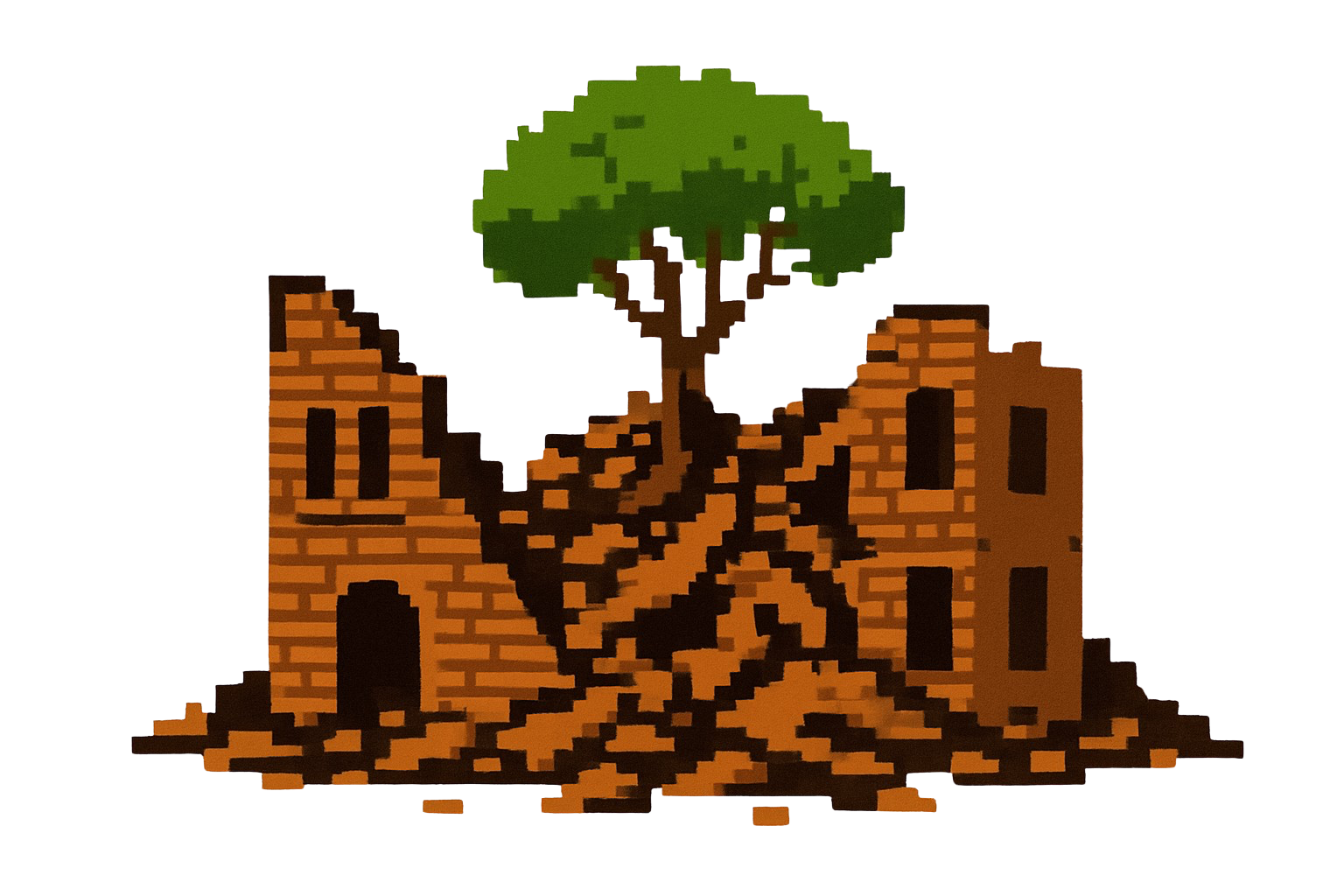
I had a head full of W G Sebald and his ‘Rings of Saturn’, although without any plans of my own to write a book - I simply looked for the quiet corners of the city and found everything I was looking for: winding walkways of broken concrete snaking up branch shadowed hillsides I’d never encountered before at the rear of art deco building complexes I was only marginally aware of; abandoned hospitals in groves of dense trees, slowly being turned into robotics warehouses; and, the crumbled jewel of the afternoon, the ruins of the Jolly Roger pub, where I easily trespassed through a flapping balsa wood boundary and found myself in a dreamlike quadrant of decimated brickwork and steps that rose onto a second storey of dilapidation where mature trees breached the gaps in the flooring and pierced where the ceiling would have been.
Urchin: Issue 5 - Winter (2005).
Welcome to the Fifth Symphony of Urchin. Contributors from all across Newcastle have once more sent us their thoughts wrapped in words so that we may give you an idea of what Novacastrians are contemplating and creating these days.
Winter has decided to visit our town again for a few months. Beneath this heavy night-time sky I can hear the rain pour down like a flood of thick brown coffee as it warms the dreams of a sleeping world. This feels like the perfect weather for reading the pieces of writing published here. During the weeks and months before Winter, these compositions were jotted down in weather more balmy than this.
Many of our pieces mention early morning and sunshine in a way that allows us to prove that more temperate times did exist in Newcastle, just in case Winter should decide to never leave. Just in case our harbour freezes over and our streets are smothered in snow, we will have an historical document making claim to a time when we could walk the streets at dawn without catching the flu and when we could lick as many sign posts as we desired without getting our tongues stuck.
As far back as I can remember, I have wanted to both write books and compose music. When I was 7 or 8 I told my parents I was working on a text called ‘How Life Works’. They said it felt ambitious for a young boy to commit to a project with such a broad focus, but I thought at the time, why not now? I’m so close to the start of it all, to the starting gun of birth, to learning how to write complete sentences - surely it’s easier to write a book about what it is to be alive at 7 or 8 than when you accumulate the weight of the following years and have to take into account all manner of learned complexities that any given adult hour adds to the strata and architecture of it all.
Midway through my university degree, after publishing some stories in the student magazine Opus, I heard about a local street press named Urchin. It was located on the second floor of TPI House (The Totally & Permanently Disabled Soldiers Association Of Australia), across the road from the Conservatorium of Music in Newcastle, where I learned the pipe organ during high school, adjacent to Civic Park, on which I used to gaze from a high window instead of practising my scales. I turned up one night for a meet and greet and began contributing to the following issue. The issue after that, I was the editor.
Yesterday was not today.
How many yesterdays
do you need, given the
way they disrobe and
misremember tomorrow.
So you kissed her last night:
what brings you back now?
After the publication of my first piece in Urchin, a letter arrived at TPI House addressed to me, saying how much they enjoyed what I had written. The letter had been produced on a wonky typewriter, signed by someone calling themselves Avis Birtles. I was well chuffed to receive what I considered my first piece of fan mail (and, regrettably, arguably my last) and decided that I would like to keep it and put it on my shelf at home.
Absolutely not, I was told by the kind but ethical administration assistant - this is Urchin property, we might want to publish it or add it to the archives for future use: hands off. This didn’t sit right with me, as the letter was addressed to Craig Smith and was in response to work I had personally written. So, I pocketed the letter, took it home and placed it on my organ music stand for however many years until I moved out of home.
On this most recent day that I spent by myself in Newcastle, riding and walking in search of resonance towards commencing ‘Their Most August Public Organ’, I couldn’t help but compare its outcomes to that day thirteen years ago when I ended up in the ruins of the Jolly Roger. Not long after that day, looking back on the photos I had taken on my wander through the ghosts of the city, I sat down at a desk in my backyard over the Summer and began to write what became my first novel, ‘A Complicated Surgery Will Take Place On The Beach Tonight’. I had inhaled the city, had started on the top floor of a multistorey carpark and, piece by piece, brick by brick, had eaten my way down through the carpark, onto the terrace homes, the alleyways, the trees, all the way to the beach at the end of the world / Newcastle to then wash it all down with salt water.
A Complicated Surgery Will Take Place On The Beach Tonight: Chapter 1.
I extend a profound friendship to all that is fleeting and undefinable and incomplete. Better living without geometry.
I used to believe there was a foundational concrete mathematical reality that must reside at the centre of the world in order to provide a platform for some unknowable, unspeakable truth to stand atop so as to give our daily reality its solid form. It would take some years until I realised that each time I thought I could hear some truth at the centre of the world I was actually only listening to an echo rising from the centre of myself.
Aimless walks are a gift. These past couple of days I have been mostly successful at extracting myself from the bedroom so as to topple out the front door and onto the street where I bounce down octaves towards the triangular shards of light in the quiet parts of the city.
I am still surprised at just how many spaces I come across for the first time which for an area that only stretches some five square kilometres feels like a curious personal oversight. Just yesterday I visited the site of an old pub I had never seen before that is in the late stages of natural deconstruction.
In contrast to that day, spent in a Sebaldian dream of the city, my recent venture involved less dilapidation and more gentrification. The city of my grandfather is gone, so too that of my father, and now the city of even last decade has been smoothed over: the empty multistorey carparks I so cherished and took my son through only a couple of years ago are now demolished and either replaced or in the process of being replaced by stark apartment complexes.
The opportunity to walk through some half-finished daydream is all but gone - instead, I ate Korean fried chicken and drank rice wine at a nice little venue that has replaced an old City Council information centre (when I was in primary school, I used to go in there to get maps for school assignments) and then I went into a bookshop that has replaced the luggage room in the train station my father and his father worked at.
Gone, too, is the ease with which I turned on the linguistic firehose in my mind thirteen years ago. There was immense pressure behind the hose back then which had been building for years, and I found a way, shortly after, to turn on the hose and let the contents out of my head and onto the page. Today, the pressure is still there (a relentless desire to turn the world into words, that form of neurodivergence aforementioned that transmutes, via countless hours of self-imposed isolation, an oversensitivity to life into a moderated simulation on the page), but the ability to turn on the hose is not so readily achieved. Or, less abstractly, this city no longer inspires me as it once did.
I’ve written over a hundred thousand words on Newcastle since that time. Now, as much as I am still drawn to the streets, I can’t help but wonder if I am motivated more out of nostalgia than the potential of instigating something new here. I find myself looking back a great deal these days, and yet I know that anything I end up creating of value will not be tethered to the past, but will be fervently invested in some unimagined future. That’s what I was looking for recently, somewhere in the city. Unable to locate it, I did what I do a lot these days - I turned away from the streets and went for a swim.
And girls who want to know
something about the moon.
Well, we used to live up there
before it became a backdrop
on pinball machines and two
dollar trinket chests, dolphins
jumping ‘neath rainbow arcs:
Lost dog signs, evening barks.
Old beaches, new carparks.
Love is all you don’t give away
(and girls who want to know
how to dissolve on the freeway).
I’ll tell you something that fascinates me about time. That note I received from Avis Birtles, typed with mechanical arms and black ink, on a piece of white paper: it turned off-white a couple of years later. Looking in a drawer right now (I’m sitting in my office at present, on a hot Summer’s night, listening to ‘Music Has The Right To Children’ by Boards of Canada) I see a couple of old artefacts from decades past: a photo of my great-grandfather on my mother’s side; a letter sent by a friend during our teenage years; a paperback Hermann Hesse novel from the 1960s - they are all yellowing, discoloured, curling up at the corners. Time has impacted everything I hold in my hands here tonight, as well it should.
But consider an online blog written thirty years ago, archived perhaps from an Angelfire or Geocities or Xoom site: when you bring it up today on the screen of your MacBook, there are no detectable signs of physical aging. Sure, the GIFs have compression scanlines and the minimalist design options are a sign of 36.6k modem load times during the late 90s, but the text on the screen is as bright and crisp today as it was back then (likely more so). It’s almost too basic to point out - aesthetics aside, the pixels on your monitor today will render digital assets of the past just as they did when they were first produced. Their bits are timeless. They do not age like objects in the physical world because they are held in a state of eternal suspended animation.
The challenging part of this is that there is no sense of distance from one digital object to the next. No gap between past and present. A retro video game from the 80s, like on my childhood Atari 2600, can be played using emulation software on a computer today alongside a similarly designed game from this year and they will look identical: the Atari game will not have yellowed, will not have depleted its colours or curled up its graphical borders, because it is now part of the world of digital infinities.
When distance is rendered obsolete within the media that comprises our cultural landscape, our awareness exists in a permanent state of immediate proximity. There must be a gap between the traveller and their destination, between the passage of time from one moment to the next, otherwise we can only think within a space that Grafton Tanner calls Foreverism and Mark Fisher referred to as the “slow cancellation of the future”. What genuinely new ideas can be given air in this space? Instead of progress and revelation, we are stuck inside a cultural hamster wheel recycling digital infinities en masse - no new movies, just remakes and sequels; no new music, just remixes and interpolations (or, as is happening this month, human cover versions of chart-topping AI songs, as if the End of History wasn’t already too on the nose).
The butterflies and the marigolds
are ontologically incomplete.
Similar news on a nearby star:
It goes without saying - go again.
And, the challenge facing me as I return to Newcastle for inspiration, thirteen years after my original revelation: to conjure new forms of prose that can break through the modernist loop of the last century. The tired techniques of fiction, inventing characters that the omniscient author moves about on a pretend stage to say more of the same, decade after decade; gonzo autofiction and pastoral essay; but where are the new thoughts, concepts so disorienting that it doesn’t seem possible that a human in our age could have given them air within the linguistic frameworks and economic incentives we supplicate? Anxiety of influence, hauntology as market aesthetic, dead air time.
In part, this challenge of creating something new out of the foreverist loop we collectively inhabit, infused with all the digital infinites we continue to accrue, strikes me as something that I wonder if AI can help solve - not through coming up with its own new ideas, as AI is the ultimate nostalgia machine, the final remix of human intelligence, taking all that we’ve ever made and feeding it back to us a trillion times over without finding a fissure to breach some wholly novel invention. Rather, I want AI to challenge us by underlining the parts of our humanity that are all too readily standardised.
When, in some quarters of our present society, we become frustrated that AI has been tasked to mirror another special part of our human potential - writing poems, connecting with others, falling in love - we might rather see this inertia as a call to action: what of our humanity can we retain after the parts of us that can become standardised are all-too-easily committed to algorithm?
Have we not been guilty of, for generations, living through such normative templates of social production that we have intentionally made ourselves ripe for automation - the generic patterns of small talk, career aspirations, punchlines, hobbies, work requirements, birthday card messages, consumer profiles, wedding vows, trajectories through the ebb and flow of life and death at the End of History, replayed endlessly in front of our eyes from every vantage point, teaching our dreams how to fit the formula, the right duration for a length of music, the right length of a book to sell for the recommended retail price: at the risk of victim blaming all of late-stage-capitalist humanity, if AI has been able to duplicate our creativity too quickly, perhaps we didn’t do ourselves any favours by colouring within the margins of our potential for so long.
So then, what if we actively let AI replicate the parts of our standardised humanity that easily slot into market templates, and then we take stock of what’s left behind, the gap between our geometry and our irregularities, the parts of ourselves that can’t be emulated - yet, even if they can’t be emulated yet, as the arms race between our unique human capacities and what can be reproduced through software will be, for the rest of our lives, in a state of technological tension - if we can unearth brand new, special, undiscovered parts of our humanity and house them in a window of subjectivity beyond replication, then a twin path into the future may open up.
On one path, we the people may strive onwards towards historically unrealised human capacities; on the other path, across the valley, we simultaneously allow computers to move beyond anthropomorphism and become an as-yet-unrealised modality, tasked not with mirroring humanity through relatable Chat Bot dialogues but instead allowed to become something beyond our language, allowed to become raw quantum artefacts of computational energy that do whatever what they do with no relation to what is within our human heads and hearts and sensory systems.
Between these twin paths - in the valley between our irregular human ingenuity and computers operating beyond the status of doppelgänger - will be the soup of inevitable artificial replication that cannot help but automate what can be automated. If a technology exists, it will fulfil the outcome of its invention. Our job may be to come to peace with this and learn how to walk in another direction while another direction still exists.
Someone knows the name of this tree
on the footpath - where I see
a tumble of green
they see an overwatered pine.
Where I see a pole with departing wires
and cannot tell if electricity fires
or calls connect,
someone else knows the design.
I think about all of this while I float in the waters of the Bogey Hole (it’s the following morning now, not at my desk anymore but writing at a table near the beach, with my bike), in this gap between the light-void universe above the ceiling of the world and the fires that drift the continental shelves far below the fish that parry the soles of my feet, and wonder what creativity can be exhumed from the remains of the day in Newcastle. When I lift myself up on the rocks that necklace the pool to stand and dry in the sun, I am surprised to see none other than the administration assistant from all those years ago at Urchin.
Penny, I say. A quick calculation - 2005, 2025 - twenty years, almost to the month. Good god. She recognises me too, we embrace and she introduces me to a friend she’s with, a man the same age as both of us with a tremendous amount of hair around every part of his head, extending in all directions. This is Avis, she says.
I’m taken aback. It can’t be. The same Avis Birtle who sent that typed letter twenty years ago that yellows in a drawer? I ask him straight out and he guffaws massively, yes that was me, he looks at me with astonishment. All those years ago, what synchronicity. Heck. Penny doesn’t remember, and I don’t bring up how I pocketed the letter, not that it matters now. We absorb the chance circumstances of our meeting before Penny invites me to join them, they’re going to the pub for a drink - absolutely, I’ll join for sure.
We wander along to one of the many Northern Stars in the neighbourhood (within a constellation of pubs, the same lodestar appears fractured in shards across the city) and reminisce about the past. How is Malcolm doing, oh he’s lecturing at university on digital media, friendship and LGBTQIA+ online experiences; what about Samantha, she’s editing poetry journals; and Terrence, did you hear about the plagiarism episode, revoking his literary prizes, oh man. What about Bronte, yes she’s working for a sustainable farming collective, oh that’s right I met Bronte at an event last year, she’s amazing.
Avis only contributes occasionally; if it wasn’t for all the hair, I’d question whether he was really here at all. Penny does most of the talking, I respond and joke where I can. She’s as electric as she was back then. I remember, as we’re talking, that although she was formal and official in her administrative capacities, she was quite wild after hours, all of the hours, dancing on the old wooden harbour pylons at Honeysuckle teetering above the water while wearing an 80s wedding dress at 5am after an all-nighter at the Lass O’Gowrie. She was a lot of fun to spend time with. I remember we went to a circus performance one night and she put on a faux French accent the entire time. It feels like yesterday.
Upstairs, above us, we hear applause and laughter. It doesn’t sound like a television - we go to check it out, wondering what could be happening up there. We head up a winding timber staircase and find only accommodation until we see a birdcage hanging on one of the doorknobs, the door propped open, with a sign that says ‘Hermes’. Penny is the first to poke her head in, then she gestures us through the door. There are around fifteen audience members watching a two-person theatrical performance being given in this room, this pub accommodation.
We stand at the back and watch. One of the performers, a man, recites a line to the woman - “Two lone glad doves are sighing on the roof”. As it goes on, we learn that this is a play depicting the lives of Australian writers Dora and Bert Birtles (Birtles! What?), specifically the period in 1923 when both Dora and Bert published love poems in the Sydney University paper about each other - Dora’s, ‘Moon Shadow’ (“All the neighbours know // What hour you come, and when you go…”) and Bert’s, ‘Beauty’ (“let // Me kiss your mouth, your eyes, your forehead, // And kiss your breasts”) that resulted in Bert being expelled and Dora being suspended. We all applaud at the end, some fifteen minutes after we arrive, and make our way downstairs.
On the way back to the bar, it occurs to me, as I reflect on Dora and Bert reenacting the past in front of this fellow who wrote to me all those years ago, the like-named Avis Birtles, that perhaps the future doesn’t just remember the past - it auditions it until a version finally fits. History is not a timeline; it’s a boomerang, with the future arcing backwards into the past to give yesterday a meaning it couldn’t have possibly inherited if it weren’t for tomorrow.
I want to ask Avis if Birtles is really his last name or just a pen name, but I leave it. He and Penny have to go, they’re heading to see a band play at the Lass: they invite me, but I decline. I still have a few things to do before then. Penny says to me, Well, you’ll have something to write about now - how fantastic was that! And meeting us: I want you to dedicate a chapter to me. I say, of course. Surely. Maybe. Who can tell. It was so good seeing you, and meeting you, Avis. Take care.
I said Maybe, but I meant Maybe not. Big, strange, unexpected events like this aren’t what fuel me - I want the quiet, unspoken moment, the glance of sunlight in the unpopulated courtyard that means something to one person alone. All of this was wonderful, no doubt - it was so good seeing Penny, and so bizarre and satisfying to connect with this Avis character, and the spontaneity of the theatre performance upstairs (part of the Fringe festival going on in the city, I later realise). It should all look so good on paper. But the future isn’t done with me quite yet.
Back on my bike, I ride past a bookstore I used to frequent all the time during my university years - I found almost all of Hermann Hesse’s 1970s Picador translated paperbacks there, while my best friend collected Robert Heinlein from the shelf above - and then circle back to take a look inside. They have a few poetry books I put under my arm (Koch, Larkin, Auden), and then I see something that almost makes me drop them all: a thin, neat blue paperback with gold letters pressed into the cover that reads ‘Survivors of BEAUTY. Memoirs of Dora and Bert Birtles. Deirdre Moore. Book Collectors Society of Australia’.
Unbelievable. I pick it up and flick through - sure enough, there are the poems that got Dora and Bert kicked out of university, and then I read a little more and learn that Dora was born not two minutes from here, in Wickham, near the harbour. How could this be - is it here as part of an intention to align second-hand book sales with topics covered in the Fringe, or is it just another stunning coincidence? I purchase it and hold it in my hands, considering how the book, now thirty years on, doesn’t look aged a single day since it was bound. The paper is crisp, the cover immaculate. A PDF of the same would hardly look more timeless.
Wedding letter to Deirdre Moore from Dora, dated 18 December 1947.
I would have liked to be one of the Good Aunties crying into her handkerchief at the wedding. Aunt Jan did at mine and I’m sure Mother did too. Kim was indignant and knocked my hat off by accident. It was one of those poke bonnet affairs temporarily brought into fashion in an ankle-length Early Victorian revival. I had a 2/6 nosegay with a paper doily at the back of Glebe florist and a cream sandwich with caramel icing from the Civil Service.
I ride to 2 Annie Street, Wickham, the birthplace of Dora, and look the terrace up and down. The white picket fence I see in a photograph Deirdre took for the book has since been taken down, and in its place stands a tall, private hedge. The timber railings have been replaced with decorative wrought iron. It looks good; the place has been well-maintained and, for what it’s worth, has kept its original design mostly intact.
The owner comes out while I’m there, a man only slightly older than me. He asks if he can help me. I ask him if he knows that this is the birthplace of Dora Toll, later Birtles. We’re just staying here, house sitting for a friend, he tells me. Who was Dora?
Who was Bert? Who was Penny? Who was Avis? Who was I, from the vantage of the future, when enough time has passed to give all of this todayness the meaning it requires - I want to say, join me for a drink at the Jolly Roger, it was demolished thirteen years ago, we can climb the tree in the middle of the bar, there’s something up there, on the second floor, that AI can’t replicate yet, because it hasn’t yet been born.
Everyone I love is alive right now. I won’t be able to say that forever. Recently, I rode my bike away from the city (sacrilege) towards the suburbs to access one of the two major shopping centres in the region. On the way there, I turned onto the footpath and saw what can only be described as profoundly mundane: a hedge in someone’s front yard (not dissimilar to the one in Dora Birtles’ old front yard), fencing off the home from the street, covered in pink camellias.
I stopped my bike and looked at the contrast in colour between leaf and flower, the different states of unfolding each pleat of petal contained, and the anachronistic feeling it gave me of time passed, of the 1980s, a certain sense of fadedness, of Kodak photographs in an album, which is what must have been the Proustian catalyst to the sudden twin sense of gratitude and melancholy that rose within me: the sense that everyone I love is alive right now but won’t be forever.
My mother and father are both alive and well, as are my wife and two children. This is my immediate family unit, and where my love most purposefully dwells. And, critically, I tell myself that it is because they are all alive and well that I can sit here, on my bike seat, during the stasis of an unencumbered mid-morning, and enjoy flowers so easily: my mind is at peace, I can access my family, we can share this world together in real-time, our memories and observations, for the brief period we’re all here together.
The flowers contain flowers
in their bulbs, the skylights
that turn on automatically
in the morning, but then you
can switch them on again to
a higher position, a brighter
sunbeam, a more intense and
vibrant colour spectrum, the
wallpaper that makes the real
thing look like nature’s yawn.
If I could give my children, my wife or my parents anything at all, it would be the knowledge that I love them with such completeness that my highest aspiration is for them, too, to sit in front of a camellia bush and do nothing except enjoy the colours, the states of unfolding, and the knowledge that I have likewise experienced this moment, in my own time. What’s that line, from Jacques Lacan - love is giving what you don’t have to someone who doesn’t want it. In my case, I want to give an impossible thing - a gap - to those with their own unfillable spaces.
I sometimes fantasise about what it would feel like to be the only person alive in the world, fuelled in no small part by my reading of ‘Wittgenstein’s Mistress’ by David Markson (I think of the protagonist, alone, throwing tennis balls down the Spanish steps into an empty plaza, camping out in the Met, living on the beach). Years ago, I tinkered with the idea of writing a series of Empty World Meditations, a guided relaxation podcast that would bring the listener into an idyllic state of isolation.
The reason I mention this, about feeling alone in the world, is that I sometimes wonder if it can dovetail with the knowledge that everybody I love is alive right now. Damien Hirst once discussed naming an artwork ‘I want to live forever, for a while’, which he said is essentially what it feels like to be alive. I wonder what my equivalent would be - ‘I want to be alone in the world, while all the people I love are alive and well’.
Empty World Meditation #3.
You walk down the middle of a two-lane freeway. The sun is high and warm and there is silence in every direction, all but your light footfalls on the road that tread now down an access lane towards a township by the sea. There is a community centre there, a fruit shop, a school, a medical practice, a bakery, a cinema. You push through the unlocked access door on the side of the cinema and find yourself in a dark hallway, treading burgundy carpet. In front of you are two cinema options, Cinema 1 and Cinema 2. You make a choice of one of the two and walk inside, past the rows of empty seats, all the way up to the screen, which you stand in front of and look up at, feeling small.
After stopping by the camellia hedge, I began to draft a poem: I am on a mid-morning ride to the shops when I stop to admire these flowers in a yard and feel a distinct sense that this moment in my life is a sweet spot regarding the aliveness of my family. Then, I ride to the shopping centre, a major commercial hub that, when I was a young lad, was much smaller than it is today. I go to the back of the centre, near where the entrance used to be. There is an unused car park shelter there, too far for most folks to park and walk around to the front, and a small park with wooden tables and chairs. I remember, as I pull my bike up, that my mother and I would sometimes sit and eat a sausage roll there, thirty-five years ago.
This concludes the poem - the spontaneous memory of a lovely moment with my mother in the shadow of this hulking, brutalist concrete shopping centre grown massive in the intervening years, after having paused minutes earlier beside a camellia hedge and expressed gratitude for the past, for the present, and for holding the future at bay for as long as possible. I mentioned Proust - in Samuel Beckett’s study of Proust, he says, ‘The creation of the world did not take place once and for all time, but takes place every day.’ I wonder if the opposite is also true, on the uncreation of the world.
Recently, I have been delivering what I call my Backyard Lectures. I have been invited to stand in a half dozen yards in Newcastle (next to white painted concrete bird baths, between garden beds, with lattice backdrops, on terraced landings) and give talks on anything that seems pertinent to the present day. They started after someone raised the idea on a local forum as an alternative to hosting a band for a backyard dinner party. I contacted the poster, and we made it happen. From there, word travelled, and I gave talks to others, audiences of ten to twenty people, during balmy Summer evenings around the city.
I tested out some of the ideas I’ve been discussing here, words written during the day after ocean submersions, delivering them as the sun went low, feeling out their resonance with those who stood and sat around. Some of the talks yielded patient receptivity while others broke out in arguments, like one afternoon, on the topic of Australian outback hyperreality, which tumbled into a fist fight and, after the aggressor was dragged off and thrown into a pool by the host, his head only narrowly missing the chlorine glossed steps, resulted in an invitation to balm my bruises by joining the now disrobed host and his wife in their rooftop spa on one of the city’s highest points (I declined).
Why isn’t music better than it is?
Sometimes I’ll be speed walking
down a busy street, late for an
appointment, and what I’ll do is
I’ll throw my car keys over a fence
or down an inaccessible drain
just to make things really hard
and show what I’m really made of.
That’s why music isn’t better than it is.
For some of the talks, I substituted in more poetic versions of the essays. Some of these worked well enough, and my confidence grew. As Summer likewise elevated, I took an increasing number of bike rides and ocean dips, which rapidly gave rise to the idea of four connected poems - Bodies, Decades, Flowers, Nights. In time, they all failed to actualise. They collapsed after being asked to wear too much reality.
In the first poem, which I titled ‘Bodies’, I attempted to describe the aforementioned conversation with my daughter, riding on the back of my e-bike, about the progressive abstraction of the physical body in an age of non-objects and mounting virtualisation of the self. In the next part of the poem, I intended to counterpoint this notion via the night ride with my wife after drinks with friends, during which the presence of the body returns in a viscerally offline capacity.
The second poem had the working title ‘Decades’, which tried to capture the creative dialectic between my day walking around Newcastle thirteen years ago, when I first gained a sense of what could fuel my narrative voice, compared with the ride into town the other week, when the city didn’t speak to me this way. My voice would have to be established not in the crumbling remains of abandoned taverns but rather in whatever was still to be found within the city of myself, crumbling or otherwise.
All these draft poems, including the fourth, which I’ll discuss shortly, buckled under the weight of information I was trying to saddle them with. When a journalist asked a Russian ballet dancer, at the turn of the last century, what her dance meant, what it was trying to communicate, she said that if she could have expressed it in so many words, then the dance wouldn’t have been necessary. ‘A poem should not mean // But be’ said Archibald Macleish in ‘Ars Poetica’. There are times, though, for me at least, where this doesn’t feel possible, and it’s best to just say it straight.
I don’t just get this way about poetry - I am a student of David Shields ‘Reality Hunger’ when he says (I’m paraphrasing) that he wants novels to be rid of all the decorative trimmings of character, of plot, of describing weather patterns and where people are standing in rooms, their dialogue, and just cut to what the novelist is actually wanting to say: tell us what you know, the really important stuff. Explain what you want to pass on to the other humans, and don’t worry about the rest. The rest is noise.
But, do it artistically - don’t just write a dry thesis explicating your worldview. Rather, choreograph the dance. Be both artist and critic: paint the canvas an impasto white, hang it on a wall, unpack its meaning, but do it in reverse. When words can do that - to not mean, but be; but, also, yes, to mean something, just enough: then we’re dancing.
This current failed poem, about the pink camellias and the sausage roll with mum, I titled ‘Flowers’. I’ll tell you this, before we get there - the next poem that didn’t work, the one I finish this essay with, had the working title ‘Nights’. Bodies, Decades, Flowers, Nights. All incomplete, now exploded into twenty thousand words of Summer prose in the unlimited present of the city and its waters, alone in my mind as everyone I love lives forever both without and within.
Empty World Meditation #9.
You walk down the hill that overlooks the city towards the base of the multistorey carpark. Then, you walk from the bottom of the carpark to its apogee, up the rampways. Each level looks over another set of homes on the lowside. All the rooms are empty, the yards are still. One of the yards has a blue chair in it that you consider sitting in later. The top of the carpark carries a pedestrian bridge that leads into a department store. You walk into the whitegoods section where refrigerators and dishwashers sit in darkness, stainless steel monuments to a civilisation only just concluded. In the room next door the manchester and bedding beckons you to sleep until sundown, when the stars begin to blink on and on.
After riding on from the camellia hedge, towards the shopping centre Leviathan, which has changed direction since my boyhood, I wonder whether it’s actually true that this is a sweet spot in my life that uniquely allows for the slow-motion appreciation of flowers. It’s true that my immediate family is alive, but it goes without saying that this in itself does not provide a basis for peace.
At the risk of bringing in another flower here, life is not a bed of roses. Familial health, the trials and tribulations of every given day, traumas of the past, fears of the future - this is life, it is not peace. At best, if suitably dealt with, it can result in amor fati: a welcoming and embracing of fate, of all that it delivers, beyond good and evil.
This points to the more Nietzschean truth at the heart of my moment with the flowers: it is not within a hermitude of idyllic ease, within reach of still-breathing family, that I enjoy an adagio of the mind; nor is it reliant on a sustained curation of imaginary peace - no, it is because of the challenge to life and its order and continuity that one must develop a love of fate, to stand up to its weather conditions and say Yes into the heart of the world.
It is this stance that provides fertile conditions not only for the growth of flowers (for the entire history of destruction that culminates in the soil, the blood and bone, fueling those first emergent green shoots) but for a mundane appreciation of their colours on a languid ride through suburban backroads. Peace is not a lull between complications - it is knowing that it can embrace all possible complications to furnish its home.
We went to the circus together
and they showed us to the VIP tent
before the show and then wait staff
gave us each a spoon with a dollop
of ice cream on the bowl of the spoon
and the ice cream tasted so good and
then one of us looked at the other
with a tipped expression and then did
the thing we were both now aware of
and bit down on the chocolate spoons
we were both holding and went oh my.
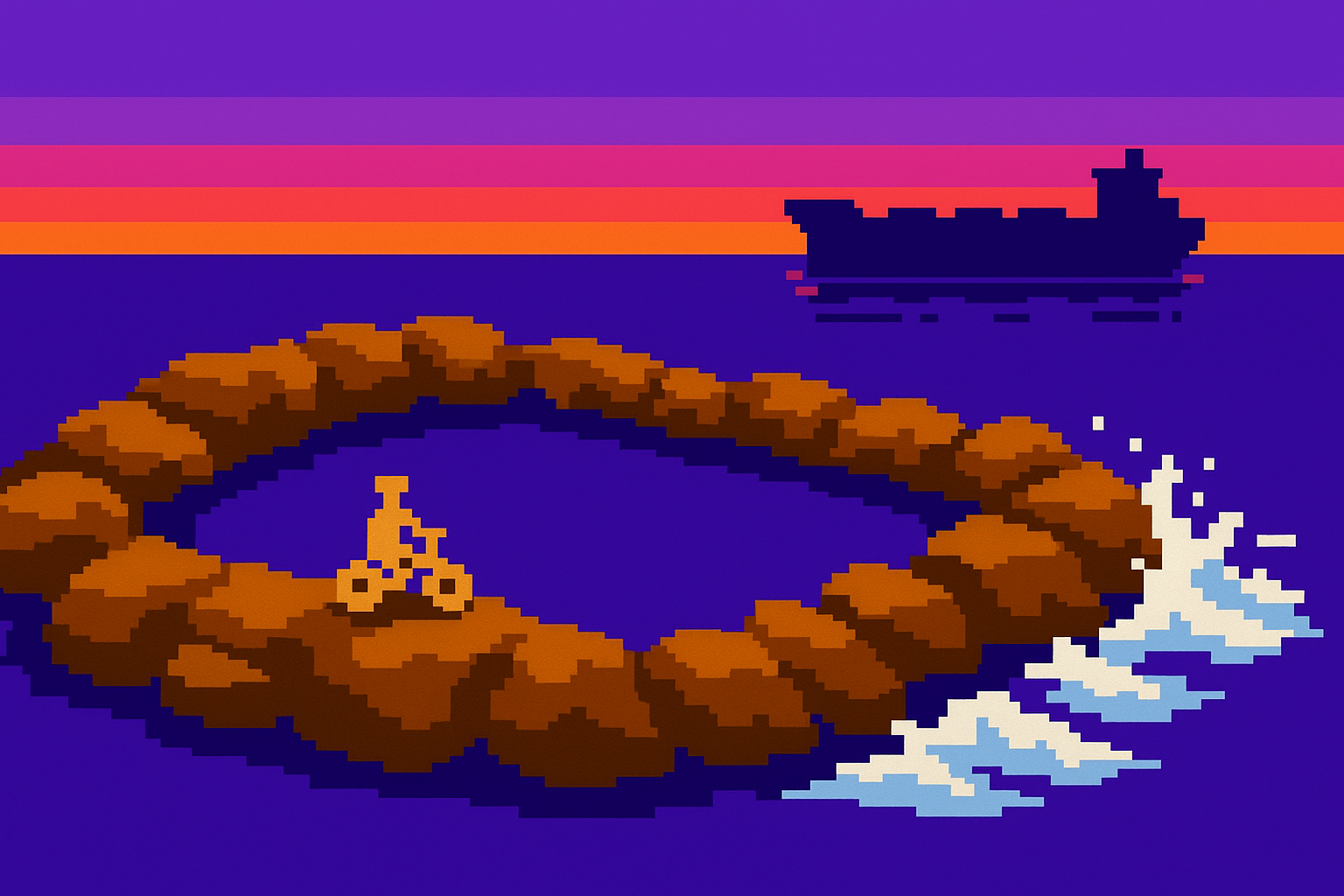
This past weekend, my son and I made a video game using an Atari 2600 emulation tool. We wanted to make a game where you ride a bike around Newcastle. The Bogey Hole was our first stage, a simple path that necklaces the water. Then, we added Nobbys lighthouse, directing the bike to jump over the concrete blocks that provide armour to the breakwall. King Edward Park came next, gliding down the steep grassy slopes. The fourth stage we built was Hunter Street Mall in its state of deconstruction, with bricks falling from the sky that the bike needs to dodge. Next, my favourite peak in the city, Bolton Street Carpark, where a rogue magpie dips in a sinewave as it crosses the screen. Finally, the most challenging stage of all - the carpark of King Street McDonald's, where a shopping trolley bounces around the arena like a DVD logo on a TV screen, threatening to knock the bike back into its Bogey Hole origins.
In my early teens, when computer game graphics just kept getting better and better, it was easy to fantasise about what the endpoint would be: a game that visually mirrored the real world. I could see it in my head, a game where you did fantastical things in a world that looked indistinguishable from outside the screen. The pixels that turned into blocky polygons would be smoothed out with each new graphics card, like Rodin and his assistants taking a block of marble and rendering it into a mimicry of life that makes the organic human body look falsified in comparison.
However, as it went, the portability of games prevailed, and user experience triumphed over visuals. The ability to play a game on a mobile device was a bigger market driver than folks sitting in front of powerhouse computer workstations and consoles. Minecraft made the leap from desktop computer to iPod Touch and graphics never really mattered again - retro, classic, big blocks, big pixels: this was preferable, it allowed for infinite landscape generation and a level of sandbox creativity that was the new standard for gaming. Terraria, Roblox, Stardew Valley, on and on. Having grown up on Atari 2600 graphics, the nostalgia was palpable, as all foreverist End of History time-loops are, when the future keeps turning to the past.
I think about the bike game my son and I have made - Ridin’ Newcastle - and daydream about another, similar game that I could make where, instead of riding a bike around Newcastle, I could wander through the memories of my past in a 4-bit topography. Atari versions of my life within cubist parameters. I’ve always been interested in games where you did nothing much - no action, no violence, no competition. I read an article about the history of handholding in games the other week. What a beautiful idea: play dynamics that allowed characters to grasp one another by the hand, in companionship and love, and drag each other across the screen. I like that.
Empty World Meditation #27.
You walk into an industrial economic zone that was originally constructed for a Summer Olympic bid that didn’t eventuate due to miscommunication. There are twenty hotels within a four block radius, a swimming pool never filled, a video game arcade with titles of games that are not quite the real thing. On the roof of one of the hotels, you survey the land, as you always do after you’ve made your way to the highest point. You can see motorways and mountains, desert plains and, far in the opposite direction, a caravan park beside the sea. If you piled these twenty hotels on top of each other, hung onto the railing on the roof of the top-most hotel, and allowed this stack of buildings to bend like a fishing rod, rubber geometry, towards the desert, and then let them to spring back up to a straight posture and you suddenly let go of the railing - you’d fly into the caravan park and start life again with a new name and a different technique for dreaming.
Perhaps I could make a game out of stopping on the footpath by the mundane hedge with the pink camellias while the character thinks about those they love. I can see it now - pink squares on a green rectangle, a grey strip for the concrete path, white and brown tessellations for the house behind the hedge, four different gradients of blue for the sky. And the character, monochrome or near enough, pillbox helmet on a pillbox head, standing front on, looking at the flowers while memories blink in slowly, bit by bit, every horizontal line drawn and redrawn constantly due to the lack of onboard graphics memory in my consciousness, to diffuse the world and replace the scene.
My wife would be there, yellow dress on, dangling her legs over the boundaries of sunset on the wall behind the restaurant that never opens; my daughter, playing with plastic barnyard animals in our yard, wearing a bunny suit and pushing a bowl of dry ice on a swing in slow motion; my son, walking the gas pipelines that breach one edgeland for another, behind the university, downriver, night vision goggles on; fishing with my dad by the cooperative on the harbour, yellowfish and roughy, treading the alley behind the first home built in Newcastle that was invisible to he and his schoolmates across the road because they didn’t know it could be seen; that sausage roll with my mum at the little wooden table and chairs, all the brief hours of childhood and youth, the blue plastic hobby horse in the photographed park where my smile was first documented.
Of course, there would be my dog, Jonsi, too. The service he provides, as many dogs do: an invitation to walk for the sake of it. Under subtle provocation, in this pixelated landscape, the character would guide the joystick in one direction, and Jonsi would take things a literal step further, granting the player permission to walk into places that you procedurally shouldn't be able to. You would walk through walls, holes torn through the security fences of industrial estates, into commercial buildings with doors left ajar, impossible that the designer of the video game would have even thought, even had the capacity, to build out the interior of a space that should have remained inaccessible to the player.
But Jonsi would take you there, into the ontologically incomplete, onto rail corridors, private property of every stripe throughout the city. Your blocky brown Finnish-Lapphund would be your psychogeographic ticket to unfettered urban exploration, because your player is just following along - sorry, security guard, he must have picked up a scent and got carried away, I think he was chasing a rabbit. We didn’t even realise you could go out of bounds. Then, once on the other side, you would push a button and give Jonsi an extra treat for being such a good boy.
My dear friend A would also be in the game - listening to Orbital on evening drives around the neighbourhood in the last splintered embers of the 1990s, recreating the true history of nihilism in Western Philosophy against the backdrop of all-night service stations like some imagined but unpainted Edward Hopper scene, early morning climbs up rocky hills that overlook cities and lakes we can no longer place, blinking off the map somewhere, post-geography.
Perhaps my other friends would be there too, the formative ones from my teenage years. At certain times - after reflecting on married life and twenty years in the workforce - I host imaginary conversations with these friends in my mind. I make jokes about how we’ve actually reached this point in our lives, considering how we were as teens, the miracle of it all, the long mid-morning of our growing up. They laugh, they offer their own hard-earned wisdom, hair depleted, soft middles. But it’s all fiction because other than A, I don’t see those friends anymore. I’ve tried, but the emails and messages remain unanswered, relegated to the void.
I could have these conversations with colleagues, new friends, acquaintances, but there wouldn’t be any point to it. Not really. The only reason to talk about these things at all would be to contrast them against the teenage world that defined everything that followed. Those few years when we crystallised our aesthetics and our ideologies, when we realised how vital close friendships were to our capacity to define ourselves against the bounds of another just like us. Maybe my own proclivity for isolation has rendered me separate, or maybe we all share the same temperament - the same thing that brought us together, tuned to the same remote frequency, is what has brought the seasons to pass for each of us alone in our own private distance.
This would also need to be included in the game. It all would be. The only problem is that I wouldn’t be able to find a suitable spot to bring it all to a close. There would be too much to include - this would be the point, of course. If there wasn’t too much to include, too much to say, there wouldn’t be any reason to even start. The abundance is the reason, the meaning. It is the maximalism of it all that gives memory the clearance to levitate when something all too simple and bright comes into view - a footpath, a house where everybody who has ever lived is currently waiting for the bell to ring, behind the hedge with the flowers that never close, always half open, ready to remind you that you aren’t, and can never be, truly alone.
This morning, I was walking through the park with my dog when we heard a loud crack followed by a tremendous thud. The branch of a Moreton Bay fig, some fifteen metres long, had fallen from its trunk and collapsed in a remarkably safe position, only partially crushing an old fence that had been bent by similar former acts of gravity. Within the gap rendered by the break, at the juncture between trunk and branch, a mouth of splinters showed, with salmon pink juts and burnished yellow triangles overlapping one another as thick white streams of sap dripped down to the root system beneath a bed of leaves.
I stopped to photograph the scene, having done the same over the years as other beautiful versions of the same variety of tree dotted around the park have succumbed to the same interplay of seasonal harm (too much water followed by too much dearth) and the cruel irony of the tree outgrowing its ability to keep growing. A man twenty years my junior walked up to me and released an emphatic woah. Look at that, he said. It’s so beautiful. Why did it have to fall like this. He reached towards the tree and I looked at his naked back (he was shirtless, having just been to the beach) and saw, no joke, the tattoo of an immense tree that for all the world could have been a Moreton Bay fig. If only his tattoo showed the inked tree with a fallen branch, too, it could have been some flora-based retelling of ‘The Portrait of Dorian Gray’.
Summer has been turned up to full strength this week, so much that my son told me earlier, while swimming in the canoe pool beside the ocean baths, that it felt like Newcastle had two suns above it. Maybe it does, but tonight they are elsewhere. An angel with neon wings, a halo of audio-synchronised lights, and a ballerina dress with a sparkle swarm of fireflies at the hem, skirts the waterside harbour where I sit and write these words. A cruise ship sits opposite the coal terminal; a party boat with a rainbow colour cycle of LEDs passes by as its revellers cast their voices across the flat waters. I have a notepad and a copy of ‘Cat’s Cradle’ by Kurt Vonnegut Jr, and if it wasn’t a Saturday night and so close to Christmas, I’d have found somewhere much quieter to sit. But this is fine. It’s nice to witness the punctuation of the year as it unfurls.
The dark transitions in
like rain made from black:
it starts in the sky and falls
in vertical lines until gutters
fill with universals of dusk,
a nativity of post-light.
I perch like a closed smile
behind the water, in front
of the city, on a ledge that
overlooks Australia, time
and its associates, primed
in its overcoats of meaning.
The pages I read from are
blank until the light bulb,
hanging from a skyhook,
transitions in a fall of text
in vertical lines, typecast,
until shadows fill in the rest.
This has been a pattern, recently. Once my family is asleep, I get on my bike and ride into the city. Down the hill past the tavern with its doors closed, staff wiping down tables; past the quiet bus terminal, gates closed for the night; across the two main roads that contain no traffic now, onto the harbour where small blue lights illuminate the foot bridges, coal ships bathed in a starfield of spotlights; then onto wherever I can sit with enough illumination to read.
Tonight it is in the little park with public BBQs near the water, but other nights I have sat on the hill near the old stone fortifications that overlook King Edward Park, or behind the cinema on a seat beneath a radio tower, or in the empty food court above the arcade scheduled to be demolished (both the food court and the arcade, and everything between), or in the rotunda in the park, or any of the walls by any of the beaches, the steps of the library. Wherever an incandescent bulb allows for size ten font in a paperback to be read with ease, I park my bike and set up for an hour of quiet, uninterrupted, nocturnal literature.
My recent selection of books has included Vonnegut’s aforementioned masterpiece, some autobiographical essays by Hesse (including those before and after both World War I and World War II, and a recent reread of ‘Siddhartha’ and ‘Rosshalde’), a collection of Sebald’s early writing on other European authors, a collection of Walter Benjamin’s iterative essays that developed into his composition of The Storyteller, the poetry of Edward Thomas, ‘In The Second Year’ by Storm Jameson, ‘The Return of the Soldier’ by Rebecca West. These selections reflect where my midnight mind has been furrowing lately, across weeks of heat building on heat, two suns above the city. For reasons that may seem obvious or strange (this is partially what got me into the fist fight in that Backyard Lecture), I have been thinking about war.
The obvious reasons are exactly that - daily headlines speak to the ongoing war between Ukraine and Russia, the Sudanese civil war, Israel and Palestine. Beyond the headlines, there are videos and reports from other quarters, but beneath this, in the subtext of podcast banter and political asides at rallies and demonstrations, an increasingly prominent narrative has emerged about the potential for new, active wars between nations currently only frustrated with one another. Not because of the usual outcomes, of the redrawing of maps or the procurement of resources or the eradication of a people, but for the existential moral benefit of the invading nation.
We need a war to give our young men a purpose, and to give our young women a supply of men who have purpose. This is the sentiment: because we have strayed too far from the epicentre of historical holocaust, we have lost a feeling for moral absolutes and an associated sense of why we’re alive. And, it’ll serve a practical economic purpose as well. If technology will do the work of the future, then the ninety-nine percent of humans in the cities and the suburbs, those not tending to the data farms of cyberpastoralism, will either have to choose between an aimless future of drug addiction or, instead, a return to the golden era of warfare. This is the dialogue.
Graffiti on Hunter Street and King Street:
The old world is dying and the new world struggles to be born (spoken by a three-eyed version of Blinky Bill, with a mechanical leg and a bindle over his shoulder).
How do you get out? (beside an ink dripped cartoon head of a greaser on one side and a kneeling naked female torso on the other).
We are all puppets in this game called life (spoken by a rabbit on a paddle pop stick).
Reading across these Summer nights, the apparent trajectory falls into place. When Nietzsche declared the Death of God, it took the foxholes of World War I to bring faith back into Europe. Good and evil took clear sides, but then, after the wars, morality drifted. Nihilism set in, Dadaism - war didn’t provide a bed of moral certainty, it just further widened the void at the centre of the human dream. But there were pockets of post-war puritanism: in that book I picked up after catching up with Penny and Avis, on Dora and Bert Birtles, there is a quote from Dora in which she says how prudish the University authorities were after the war, leading to the expulsion of her and Bert after the publication of their love poetry. Dora and Bert were redefining what a post-morality affirmation of humanity could look like (Nietzsche’s twist on Shakespeare, That which is done out of love always occurs beyond good and evil), but the centres of political power, the ones that waved the flags of war, said we haven’t got the luxury for that now.
The holocaust brought it all back with clear delineations of good and evil, and the nostalgic romance of this dialectic seems to have been culturally intoxicating. Just read any of the adventure paperbacks from this period, or the cinema that followed - heck, go straight into Salinger and Pynchon: the rain and the choir and the tearoom where the narrator talks with Esmé and her brother; and then, Jessica and Roger during a night drive coming across a church in the snow - again, it’s wet and cold - with another choir, “this is the War's evensong, the War's canonical hour, and the night is real” followed, in time, by the following declaration, on Jessica and Roger’s wartime relationship: “They are in love. Fuck the war”.
Not so, as their relationship dissipates once the glow of war depletes. In a coarse turn of the line by Pynchon, we might say they fuck because they are in love with the war. Something about death being right around the corner, clear roles and responsibilities, being not necessarily on the right side of history (although that is a plus, for those who can house such simplification) but of history, of any history, just being involved in a bracket of time that feels like it will mean something later. The future will define the present only if we deliver it something worthy of reflection.
When the sun leans back, low
enough so all that remains
turns to silhouette, flat black
against embers, I imagine the
opposite when the sun returns,
all standing monuments now
white without perspective, no
colour or gradient - without sun,
no light; with sun, all the light;
a monochromatic world, but for
sound too - the train whistle is
present, but when it fades away
a hollow in the air stays, inverted.
For people, too, yes? All at once.
This is the present narrative that churns me up as I sit in the dark and read on these hot Summer nights in these Murmuring ‘20s. Because here’s my moral truth - I want to remain outside of history. We cannot borrow meaning from catastrophe. History is not a circle, nor is it a line forward - like all dichotomies, all antinomies, it must comprise an unresolved negation of both. Sure, the human hardware we meet the world with is the same that Aristotle used to welcome the morning, but if we were to meet Aristotle today, he would not understand us, nor we him. Time has changed us all, but the gap between the changes remains the same as it ever was.
When Thales of Miletus proposed that water is the originating principle of all things, Aristotle liked the idea but developed it further towards a concept of multiplicity, of a continuity beneath change, the flow between earth, air, fire and water. I get it, and you’ve got to hand it to Aristotle, but I still get stuck with the flux, the divisibility of it all, which is only important if we want to bring all of this back to truth and meaning: in the period of time in which we live, it feels like one of increasing fragmentation. Language and identity, neurodivergence and gender and sexuality, the line between human and not, between flesh and not, the online world in which the economically powerless - without land ownership, without capital - find ways to further hold the feet of power to the linguistic flames by imagining new ways to divide and be seen.
What is the endpoint of fragmentation, when the pieces are divided over and over again, halved and halved again? I side with Thales of Miletus here, as the night beckons me for one more swim. Everything becomes water. You break the stone up into so many atomised pieces, you get water. The walls of the Bogey Hole, carved out of coastal shelf, are slowly becoming water. The beach, the walls of sandstone and shale, are all being ground into fine pieces of matter that are water at heart.
I have frequently written about how we seek out external environments that mirror the landscapes of our internal subjectivity - the mountains, the flat expansive plains, the topology of an urban maze. If the external world is a mirror of our internal empire, which we seek to resolve and feel complete, then time and human history are surely a mirror to the technology of water.
Graffiti on Bolton Street and Watt Street:
I wish that men would stop yelling at me in the street (painted on a laneway wall).
I love my girlfriend (painted on a billiard table store, since demolished).
I still miss you so much (painted on the back of a navigation sign).
In ‘Siddhartha’, Hermann Hesse had his protagonist seek out meaning in all manner of human enterprise: as a religious man, before he realises that second-hand truths are worthless; as a wander ascetic, before he realises that he is living solely to negate life; as a hedonist, a lover of flesh, before he realises that it does not sustain him; as a rich merchant, before he realises that abundance is the same as negation; and, finally, an assistant ferryman, listening to the river and, eventually, hearing all of humanity resounding in its waters. But this is not the endpoint - it is only a finale in the narrative sense. Given enough time, Siddartha would move on from his role as a ferryman to yet another change, always without a stable truth that defines the measure of his life.
Like the irony of ‘The Road Less Travelled’ by Robert Frost, it doesn’t matter which path you take: we will always pretend our chosen destination was inevitable. And, if that takes a concerted effort by populists to divert the trajectory of our time towards war, to seek out those old pre-fragmented moral truths, then, as Kurt Vonnegut said so often, so it goes. But it’s not where I want things to go. Not even a little bit.
The wind is picking up and flapping the pages of my books, my pile on the table beside the harbour. I see a double-decker bike, literally a bike on top of a bike, travelling down the footpath in front of a chariot-style pedal vehicle, all of them covered in Christmas lights. The riders and passengers yell out season’s greetings, and I wave back and think of my family asleep at home while their dad / husband / son ruminates on fictions within fictions and whether any of it will become real. This was my fourth, failed poem - riding into the city, night after night, to sit alone and read. I get on my bike, unadorned with lights, and head home in the dark.
Text messages to say hi while you’re in the city.
Then, interruptions from people walking up to you
and then passages from the books you have read
or written, and then the town, talking through its walls.
The next morning, on what is predicted to be the hottest day of the year, I ride to the Bogey Hole for an early swim. It ended up storming last night, the third time this month that I've been caught out in the city on my bike in the rain. But other than an increased presence of ants on the park benches, there is little sign of that today, just the rising heat that will soon become overbearing.
On my way down through King Edward Park, I am called out to by a man with a heavy backpack and a sensible hat. He speaks in a strong Spanish accent and says, the beach, is there? I say yes, and point to our left, the beach is down there, and there, I point to my right, is a rock pool for swimming in. From his warm countenance that balances anticipated confusion with care, I can tell that he only half registers my response. He reaches out his hand, your name, and I say, Craig. He tells me his but I immediately forget it, as is my nature. Then he says it is his first day here. I say that I’ll hopefully see him around. We wave farewell as I glide down the hill.
I’m halfway down when I regret not having offered him a lift on the back of my bike. The fact that I don’t have a helmet for him is what stopped me, although this seems ridiculously parental now. Plus, it’s a tricky ride down on the loose gravel, and I wouldn’t want to put him at risk. I park and dive into the water - there are already a half dozen others here, some forming a circle as they chat and laugh, a few long-limbed young women glowing gold in the sun - but I only finish a few laps before I think about going back for the traveller. It would be such a shame if he didn’t see this place, because for me it is the crown jewel of the city (perhaps literally, given its colonial birth), and the idea that someone visiting Newcastle wouldn’t make it to the Bogey Hole, after walking so close to its perimeter, is something I just can’t live with.
I get back on my bike and find him thirty seconds later, sitting on a little bench facing the sea. With some difficulty, I try to tell him that I was worried I gave the wrong directions. He tries to interpret what I’ve said, but then just smiles and puts his arm on my shoulder. Look, he says. Dolphins. In his hand is a small remote control with a video screen built in, receiving feed from a drone that must be flying over the water as we speak. I can see a pod of dolphins, six or seven, children and parents, swimming together in the ocean. Turning, I cannot see the drone, but know it must be there, that he must have sat down and set things up and sent it out far beyond the coast. And to think I was worried that he wouldn’t find the Bogey Hole. He has so much cartography in his hand here that he could navigate all the way to New Zealand.
Beautiful, I say as I watch the dolphins dip and stream through the screen. I take out my phone and speak into it, I say, translate this into Spanish - I am going to be swimming in a rock pool, down this pathway to the right. I might see you later on. My phone says - Voy a ir a nadar a la piscina de rocas, bajando por este camino a la derecha. Tal vez nos veamos después. My new friend says, thank you, Craig, yes, yes. He places his hand on my shoulder, and I pat his arm in solidarity. Then I head back to the waters.